Auteur de l’article
Ah, the trail running poles… Sometimes praised, sometimes criticized, they remain a major accessory for many trail runners. Lightweight compared to hiking poles, they are increasingly optimized down to the smallest details to improve the performance and comfort of use for runners of all levels… provided they are used correctly!
So, how to make trail running poles your allies during your training? What are the mistakes not to make when using them? We'll explain.
Why use trail running poles in running?
True essentials in the trail runner landscape, trail running poles have managed to conquer a broad audience. An overview of their benefits, but also their limitations (and there are more than you think!).
👍 The benefits of trail running poles
Trail running poles involve a different distribution of effort from what you're used to in running. Indeed, when you run, you primarily engage your lower limbs. Upper limbs support, help set the pace, and optimize running economy, but they do not actively participate in the effort (except in sprint-type distances).
With your trail running poles, you will engage the strength of your arms and more generally your upper body in the effort. This will lead to a better distribution of the load and, by extension, a reduction in muscle fatigue in the legs. Specifically, they will provide you with:
assistance when climbing,
better balance management when descending,
assistance on flat terrain.
A study Giovanelli et al. conducted in 2023 (Int J Sports Physiol Perform) on fifteen trail runners concluded that the use of trail running poles reduces the force exerted by the foot by 2 to 5% while improving performance by approximately 2.5% in maximum climbs. The title of the study is ambiguous:
“Trail running poles save your legs.”
Giovanelli et al.
The finding is particularly present in long-distance formats such as ultra-trail.
👎 The limitations to their use
Contrary to what you've probably heard, trail running poles are not miracle tools for performing on trail. Indeed, in the vast majority of situations, using them leads to higher oxygen consumption than walking without them. This is what many studies (Duncan 2008, Pellegrini 2018, Saunders 2008, Sugiyama 2013 etc.) highlight.
Thus, the use of trail running poles is only interesting if it proves to be more economical metabolically than not using them. This is what some studies call the “metabolic tipping point”. Specifically, it is the moment when it becomes more economical from a metabolic point of view to use trail running poles rather than go without them. These place this famous tipping point around a slope of 26 %. This remains an imprecise average and subject to fluctuations, but the facts are there: the use of trail running poles makes the effort more demanding on the cardiovascular level.
Our trail running Campus coach, Mathieu Blanchard, gives us his opinion:
No, trail running poles do not "save"! It's a common marketing bias. Yes, they can relieve the legs a bit when climbing, but they require more energy and increase the cardio, sometimes +10 to +20 bpm for the same pace. Result: you may blow up faster and finish slower than without trail running poles.
Mathieu Blanchard, Campus coach
⚠️ However, caution: other studies are more reserved on this topic. Several of them highlight an increase in oxygen consumption of around 20% with trail running poles, but without a significant increase in perceived effort (RPE). The study by Giovanelli et al. demonstrates, in turn, that when climbing, the oxygen consumed remains equivalent. She thus concludes that performance improvement would not come from a greater effort, but from a better distribution and support strategy.
In any case, all studies agree that trail running poles offer little interest on flat terrains or relatively gentle slopes, as well as on very technical terrains.
Moreover, from a practical point of view, they can quickly become cumbersome if you haven't optimized storage technique. Finally, their use will become completely counterproductive (even annoying for other runners) if you haven't learned to use them correctly before your competition.
How to properly use your trail running poles according to the terrain?
To benefit from the advantages that trail running poles can provide, you still need to know how to use them. Whether climbing, descending, or on flat terrain, there are tips to make them your allies.
🚀 When climbing: favor propulsion
Most studies agree that trail running poles only become useful when climbing slopes averaging 26%. However, some extend the spectrum and admit beneficial effects from 15%. We're already on a nice climb!
But regardless of the slope level or terrain nature, you have two ways to manage your trail running poles when climbing:
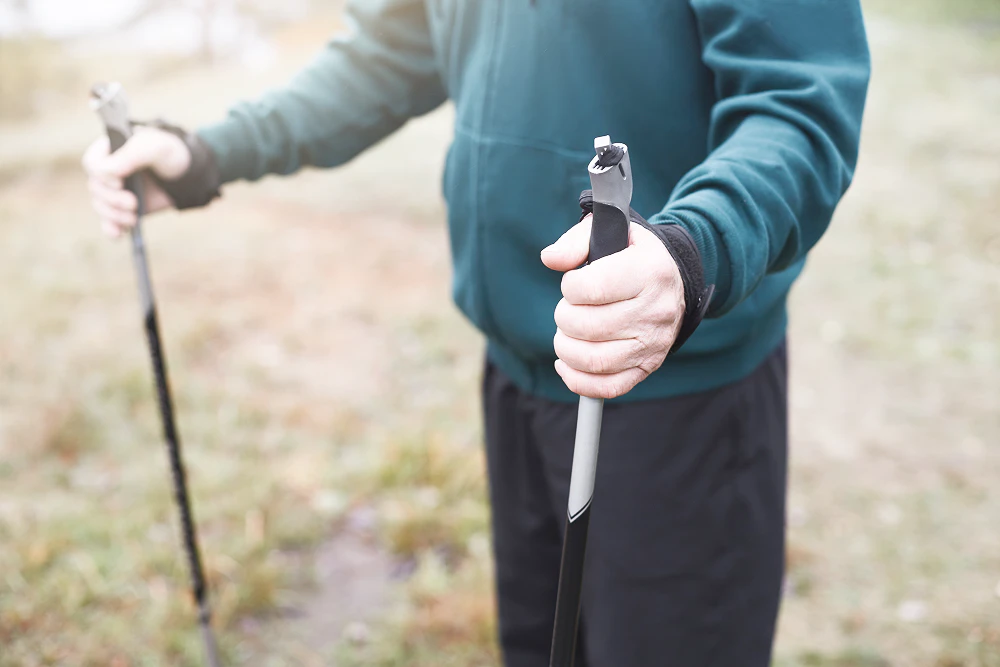
No matter how you use your trail running poles, you must especially not tense up, including in the hands. Whether you have gloves, grips, or straps, use them to support yourself so as not to grip the handle too tightly. The watchword must always remain: flexibility.
🎯 When descending: optimize stability
This may seem counterintuitive, but trail running poles can be quite useful when descending. Indeed, they will help you improve your stability and better anticipate your steps. Not to mention that they can provide additional support points in steep or somewhat technical sections. For example, if you have to go over a somewhat high “step”, you can plant them behind you to lighten your steps and reduce the impact of your jump on your joints.
⚠️ Warning: using trail running poles when descending requires good agility and regular training. The pole takes away the first option available to you when you slip or fall, which is to use your hands. You need to get used to this feeling and above all, learn to remove them quickly in case of a fall, as you can quickly twist your arm and injure yourself. Some trail running poles offer emergency release devices for this situation. It's up to you to train to react properly!
💡 On flat terrain: when and how to use them?
On flat terrain, the interest of trail running poles is minimal. They can assist you on long flat sections, but the gains are more than limited. On the other hand, you may use them between two ascending or descending slope sections, in order not to have to remove or store them to take them out a few minutes later.
In any case, the technique will differ from that used for climbing. Here, it's difficult to maintain an alternating rhythm: it requires superfluous and unnecessarily energy-consuming quick movements. You must opt for what is called 'the gallop'. You will plant your pole one step out of three in the manner of cross-country skiers. This will imprint a much smoother and more natural movement to your stride.
Note, however, that you will surely be less comfortable than with free hands and your 100% natural stride!
Choosing trail running poles properly: comparison of essential criteria
With the rise of trail in recent years, the supply of dedicated poles has exploded. It can be difficult to find your way and choose THE model that suits your practice. We give you some clues to guide your choice.
🧐 Carbon or aluminum: which to choose?
Equipment manufacturers offer different types of trail running poles with, as options, two main materials:
Carbon. It is the most 'high-end' material. It offers great lightness and good vibration absorption thanks to its significant deformation capacity. On the other hand, this comes with a certain fragility. Of course, the price is quite high!
Aluminum. It is more resistant than carbon but also slightly heavier. It may appear harder because its shock absorption is less significant. On the other hand, it is less expensive and constitutes an excellent alternative for beginner or occasional trail runners.
🔍 Foldable, telescopic or fixed poles: what versatility?
This may not have escaped you: not all trail running poles have the same storage modes. Some can be folded, often in three. Others are telescopic while still others are perfectly fixed.
Foldable poles: they are compact and easily slip into a trail running bag or a suitable quiver. Their lightness and practicality make them ubiquitous in trail competitions.
Telescopic poles: they fold and unfold on their own. This proves practical for courses with very varied terrain. You can indeed adjust your pole to be slightly longer when descending and vice versa when climbing.
Fixed poles: they are often very light but impractical to carry. They are thus rather recommended for experienced trail runners who know perfectly how to use them regardless of the course profile.
👌 Grip, glove, strap: the comfort trio
Trail poles are entirely designed to offer a comfort and performance experience. Certainly, this involves the material of the shaft, but also the grip and the holding technique.
The grips can be made of foam or cork. The latter will offer true optimal comfort, good durability, and absorb sweat well, while foam grips will often offer more lightness.
Regarding support now, there are two main methods: the glove and the strap.
Common mistakes to avoid with trail running poles
We have already mentioned a number of limitations and mistakes not to make when using trail running poles. But it's never too late for a quick recap of the main points of caution.
Not having trained to handle them: if you burden yourself with trail running poles without knowing how to use them, you add a constraint that will be unnecessary or even counterproductive.
Using a pole length that doesn't match your size: some models, the telescopic ones, are adjustable, but for others, you need to choose the right size. Go to the manufacturer's website to access the size guide. It is generally considered that a pole is the right size if your arm bends at 90 degrees at the elbow when you hold it.
👉 Good to know: a margin in pole size can be tolerated for certain situations. If they only serve you when climbing, you can consider taking them a bit small, while if they are more useful to you when descending, you can choose them a bit large. This can be useful if you are between two sizes.
Taking them out or folding them too often during the race: work on your route and be strategic.
Neglecting safety instructions: surely you haven't missed it: the ends of trail running poles are, let's say… sharp. You must therefore be vigilant when using them. We avoid wide movements, do not watch the time with the pole attached to the hand, and do not throw it backwards during the push movement. Other runners will be infinitely grateful to you.
🙏 Finally, note that many races prohibit the use of trail running poles for short and medium distances. It's not to bother you but to avoid damaging the grounds and weakening your environment. For me, who resides in the southeast of France for example, trail running poles are very rarely allowed on distances below 50 kilometers. Priority to the health of the mountain ranges! So make sure to inform yourself to avoid any inconvenience.

Ultimately, trail running poles are neither your enemies nor a miracle cure for your runs. They can help you on certain profiles when they are well used. But they require learning and good training to allow you to handle them well and not make them a burden.

Publié le , mis à jour le
In love with running and words, it is with passion that I take up the pen to lead everyone, in their own way, towards the feeling of freedom that only this sport can provide.
partager